Al-Andalus and the Culture of the Written Word: A Legacy Worth Carrying
Imagine a library so vast it held four hundred thousand volumes its shelves warm with the scent of cedar and leather, its corridors alive with the soft scratch of qalams on parchment, its scholars moving between rooms of philosophy, astronomy, poetry, and law as naturally as men move between gardens. This was Córdoba in the tenth century. Al-Andalus and the culture of the written word were, at this extraordinary moment in history, inseparable one nourishing the other the way water feeds the roots of an ancient tree. To trace that culture is not nostalgia. It is orientation. It is the recognition that the impulse to write, to record, to think in ink, carries within it a heritage of civilisation far older and far richer than we perhaps remember when we open a notebook on an ordinary morning.
A Civilisation That Thought in Ink
At its height, Al-Andalus was home to more books than the rest of Europe combined. This was not coincidence. It was the consequence of a culture in which the written word held a status both intellectual and devotional a culture shaped by the Quranic injunction to read, to reflect, and to attend to knowledge as a form of worship.
The libraries of Córdoba, Granada, and Toledo were not merely repositories. They were living institutions. Scholars copied, corrected, and annotated texts with a care that approached the meditative each letter formed with the understanding that knowledge, once entrusted to the page, became a sadaqa jariya, a flowing gift that would outlast its author.
The scribes of Al-Andalus developed their craft with the same precision a jeweller brings to gold. The preparation of ink formulated from gall, iron, and gum arabic was itself a discipline. The cutting of the qalam from cane required skill and knowledge passed from teacher to student across generations. The page was never incidental. It was the field in which civilisation was cultivated.
The Andalusian Book: Where Beauty and Knowledge Were Never Separate
What distinguished the manuscript tradition of Al-Andalus from a purely functional literary culture was its insistence that beauty and knowledge belong together. A well-made book was not a luxury. It was an argument a quiet declaration that what is worth knowing is worth preserving with care.
Illuminated manuscripts from the Andalusian tradition reveal an aesthetic sensibility of stunning refinement: geometric borders echoing the tilework of the Alhambra, calligraphic headings where the letters themselves became ornament, margins filled with the fine annotations of readers who returned to the same text across decades. The book was a conversation across time.
Leather bindings in the Moorish tradition structured, embossed, tooled with the interlacing patterns that gave Andalusian art its unmistakable character were crafted to endure not just years but centuries. The craftsmen who made them understood something that the modern world is slowly remembering: that the vessel shapes the experience of what it carries. A beautiful binding invites return. It holds the reader in a different quality of attention than a page left unprotected.
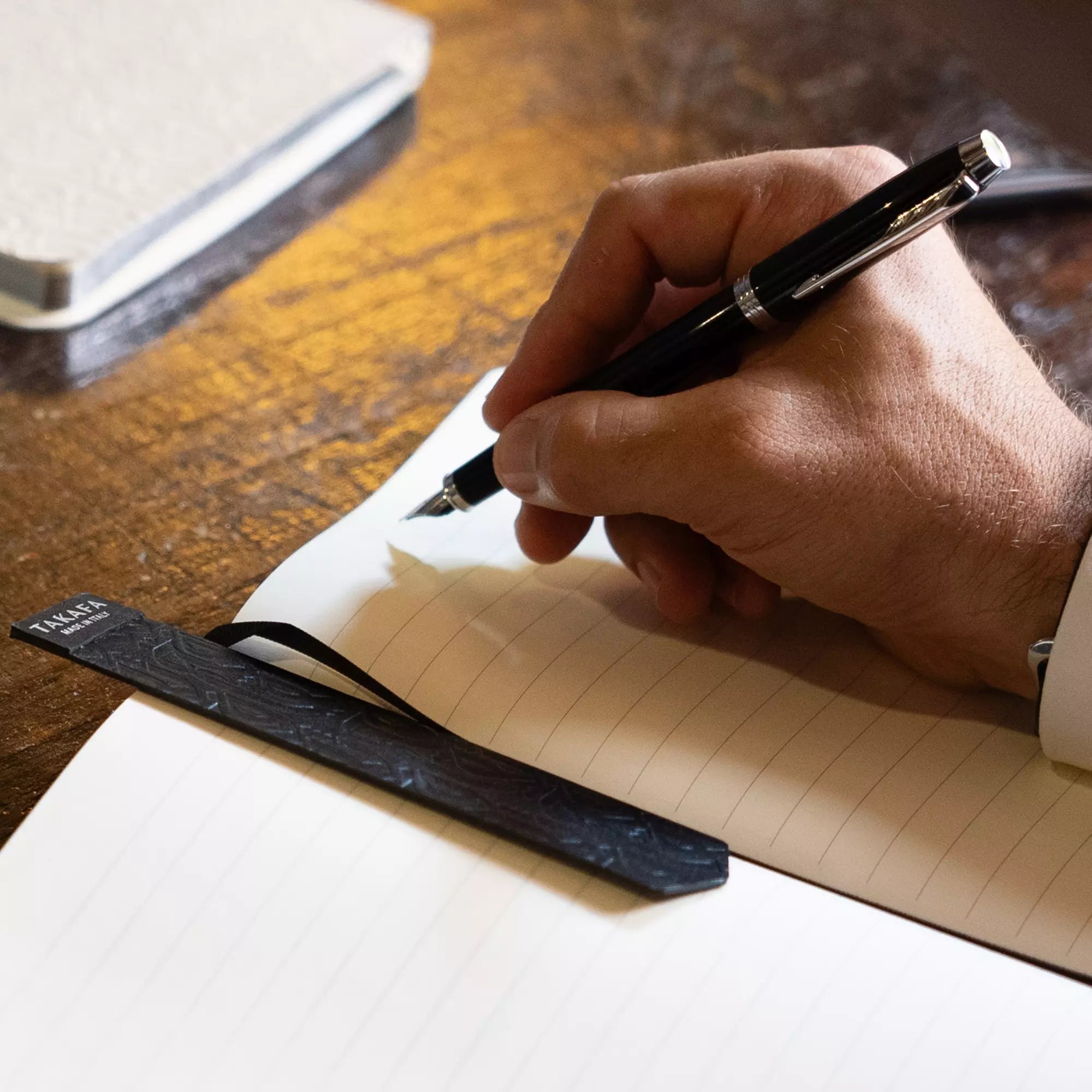
This is, in the deepest sense, what a luxury leather journal inherits not merely a material tradition but a philosophy: that the written word deserves to be held in something worthy of it.
Ibn Rushd, Ibn Hazm, and the Writers Who Shaped a World
The writers who emerged from Andalusian civilisation were not writing for archives. They were writing to think and in thinking, they changed the shape of human knowledge for centuries to come.
Ibn Rushd of Córdoba known in the Latin West as Averroes produced commentaries on Aristotle that reintroduced Greek philosophy to a world that had largely forgotten it, shaping the universities of Paris and Bologna as profoundly as any European scholar. He wrote under political pressure, with urgency and precision, a man who understood that ideas committed to the page could survive what their author could not.
Ibn Hazm, also of Córdoba, wrote Tawq al-Hamama The Ring of the Dove with an interior honesty that reads, across ten centuries, as startlingly contemporary. His exploration of love, longing, and the human condition was not a literary exercise. It was a form of self-knowledge made durable by the discipline of writing it down.
What both men shared, along with the hundreds of scholars, poets, and physicians who formed the intellectual world of Al-Andalus, was the conviction that writing was not separate from living fully. It was the practice by which a life became examined and a thought became a contribution to something larger than one lifetime.
The Garden and the Page: Andalusian Wisdom About Tending What Matters
The famous gardens of Al-Andalus the Generalife, the courtyards of the Alhambra, the riyads of Córdoba were not simply beautiful spaces. They were expressions of a philosophy: that the world responds to careful tending, that beauty cultivated with intention is a form of gratitude, and that what we nurture grows in ways that outlast the season.
The Andalusian scholars brought this same understanding to their intellectual lives. They returned to their texts the way a gardener returns to a planted bed not seeking the spectacular, but trusting the slow accumulation of care. The marginal notes added year after year to a beloved manuscript. The practice of copying a text by hand not merely to reproduce it but to understand it more deeply. The discipline of writing down, at the end of a day, what had been learned and what remained to be known.
This is what the written word meant in Al-Andalus: not a record of conclusions, but a practice of becoming. Not the monument of thought, but its living ground.
Conclusion
The lamp that burned in the libraries of Córdoba has not been extinguished. It has passed, as all true light passes, from hand to hand across the centuries through the scholars of Fès and Istanbul, through the madrasas of Samarkand, and quietly, persistently, into the hands of anyone who sits down with a clean page and the intention to think with honesty and care.
Al-Andalus and the culture of the written word left us a legacy not of monuments, but of practice the understanding that to write is to tend something, to honour something, to participate in a civilisation that measures itself not by what it builds in stone but by what it cultivates in thought.
If that legacy speaks to you if you feel the weight of what a pen in hand can carry let the notebook you choose be equal to the practice. TAKAFA journals, handcrafted in Italy and rooted in the Andalusian art of living, are made for exactly this kind of inheritance. Explore the collection and carry the legacy forward.