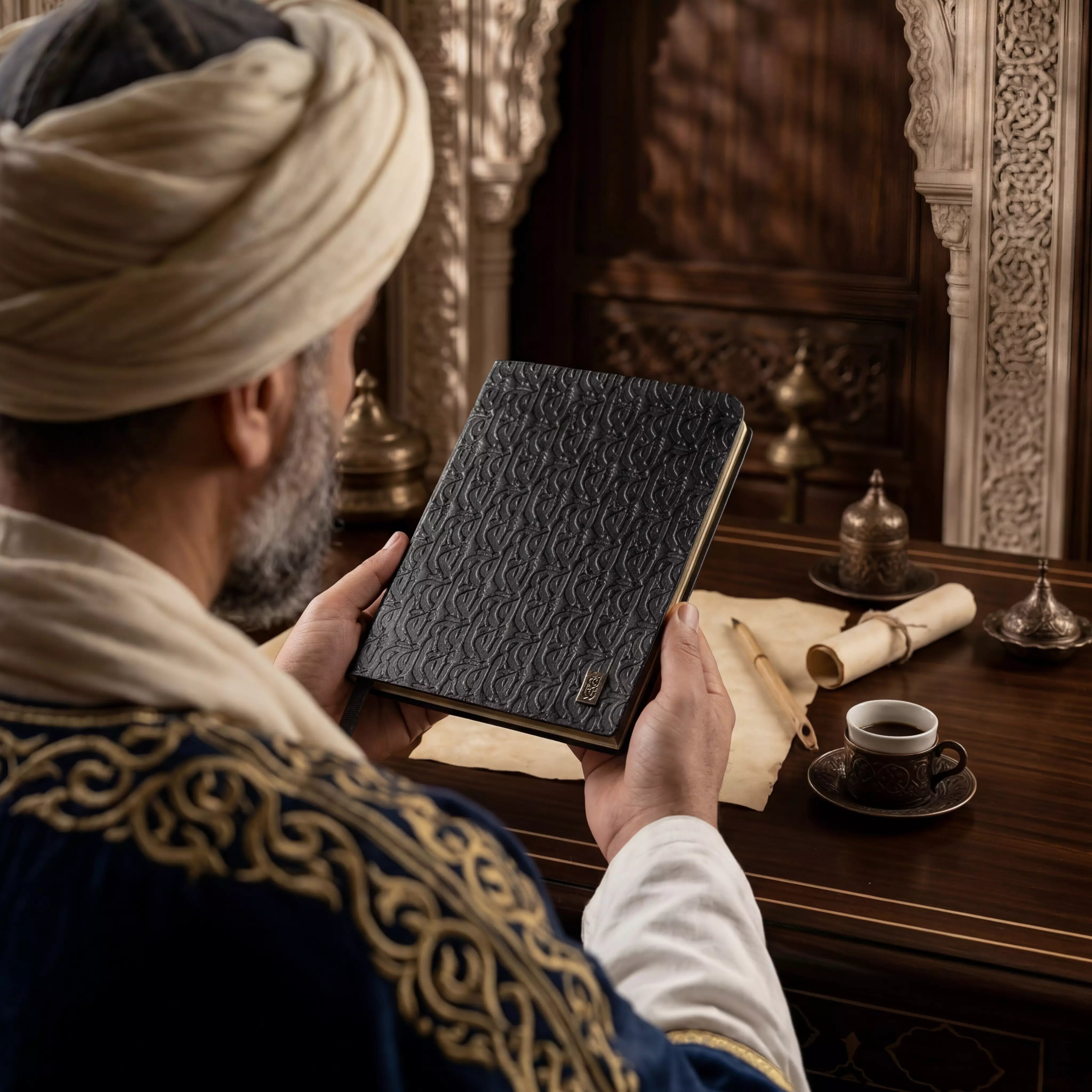
The Islamic Golden Age Had a Journaling Practice. Here's What We Can Learn From It
The candles in the library of Córdoba burned long after the rest of the city had settled into darkness. Scholars bent over sheets of fine paper, qalam in hand, not only transcribing the thoughts of others but pouring out their own reflections on what they had studied, what they had doubted, what they had understood only by the act of writing it down. The Islamic Golden Age journaling practice was not a footnote in intellectual history. It was, quietly, its engine. And the lessons it left behind are more alive today than we tend to realise.
The Scholars Who Wrote Everything Down
The great thinkers of the Islamic Golden Age Ibn Sina, Al-Biruni, Ibn Rushd, Al-Ghazali were extraordinary not only for the quality of their thought, but for the relentlessness of their documentation. Ibn Sina is said to have written while travelling on horseback, dictating to a student when his own hand could not manage the motion of the road.
This was not compulsion. It was a deep understanding that thought, unrecorded, dissolves. That observation, kept only in the mind, loses its precision. The act of writing was, for these scholars, inseparable from the act of knowing.
The qalam the reed pen, cut to a precise angle, dipped in ink mixed with soot and gum arabic was not merely a tool. It was a covenant between the mind and the page. To write with it was to make a commitment: this thought is worth keeping.
Muhasaba: The Practice of Accounting for the Self
Beyond treatises on medicine, philosophy, and astronomy, there existed in this tradition a quieter, more intimate form of writing: muhasaba literally, self-reckoning, or the internal audit of the soul.
Rooted in the ethical framework of Islamic scholarship, muhasaba was the practice of examining one's actions, intentions, and thoughts at the end of each day. Not as punishment, but as precision. The scholar or student would ask: what did I notice today? What did I act upon that I should not have? What did I allow to pass unexamined?
This practice produced a particular quality of consciousness one that was present during the day because it knew it would be asked to give account in the evening. The expectation of writing sharpened the quality of living.
This is, in essence, what we now call reflective journaling. The Islamic world was practising it in a structured, philosophically grounded way during an era when most of Europe had not yet developed sustained literary culture. The insight is not minor: Islamic Golden Age journaling practice was a technology of the self, centuries ahead of its rediscovery in the modern world.
The Rihla: Writing as a Form of Navigation
The tradition extends further still. The rihla the travel narrative was a recognised literary genre in the Islamic world long before travel writing became fashionable in Europe. Ibn Battuta's Rihla, which documented his journey across three continents over nearly thirty years, was not merely a record of geography. It was an ongoing act of self-understanding.
What Ibn Battuta understood, and what the tradition of the rihla enshrined, is that writing about where you have been clarifies where you are going. The traveller who writes becomes more precise in observation more attentive to what is different, what is common, what is worth carrying forward and what is worth leaving behind.
A personal journal functions in exactly this way. Not a diary of events, but a map of a mind in motion. The practice of writing daily:
- Captures observations before they dissolve into the general texture of memory
- Reveals patterns across days and weeks that are invisible in the moment
- Sharpens the intention behind decisions, rather than allowing life to simply accumulate
- Creates a record of growth proof, on days of doubt, that movement has occurred
The scholars of Al-Andalus understood that the examined life required examination in writing. Reflection conducted only in the mind remains impressionistic, self-serving, and easy to revise in the next moment of mood. Writing holds it still long enough to see.
What the Golden Age Teaches Us About the Journaling Ritual
There is one further lesson, subtler than the rest: the scholars of the Islamic Golden Age treated the materials of writing with reverence.
Paper, introduced to the Islamic world from China and then refined extensively in Baghdad and Fez, was considered precious. Ink was prepared with care. The qalam was shaped with skill. Bound volumes the codex form that Muslim scholars helped develop and disseminate were held as objects of worth, covered in fine leather, kept with intention.
This was not decoration. It was philosophy made material. The object of writing communicates, before a single word is placed upon it, what the practice is worth. A beautiful notebook, held in the hands with pleasure, opens more readily than one that feels indifferent to the touch.
The craftsmen of Al-Andalus knew that the garden, the tile, the carved archway, and the bound manuscript all served the same purpose: to tell the human hand that what it touches is worthy of care. The luxury was not vanity. It was an act of respect for thought itself.
The Islamic Golden Age journaling practice did not belong to scholars alone. It belonged to anyone who understood that a life examined with regularity and honesty becomes, over time, a life more fully inhabited.
Muhasaba asks nothing extravagant of us. One quiet moment. One honest page. The same discipline that animated the libraries of Córdoba, the ateliers of Baghdad, the garden courtyards of Granada available, each morning or each evening, to anyone who chooses it.
The pen still waits. The page is still blank. And somewhere in that silence, a tradition that once lit up the medieval world is ready to be continued.